Too Much of a Good Thing?
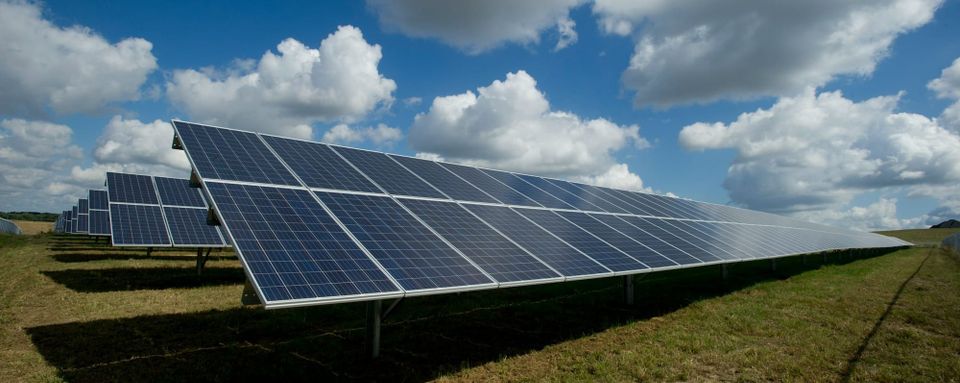
Isn’t it nice to enjoy a sunny weekend, especially if it's a long one, like the last one? Especially when it is so sunny! But can it be sometimes too sunny? Turns out - yes. And no, I don’t mean getting sunburnt. There was so much sun in Germany in the first May weekend that the electricity prices turned negative (Energy Charts):
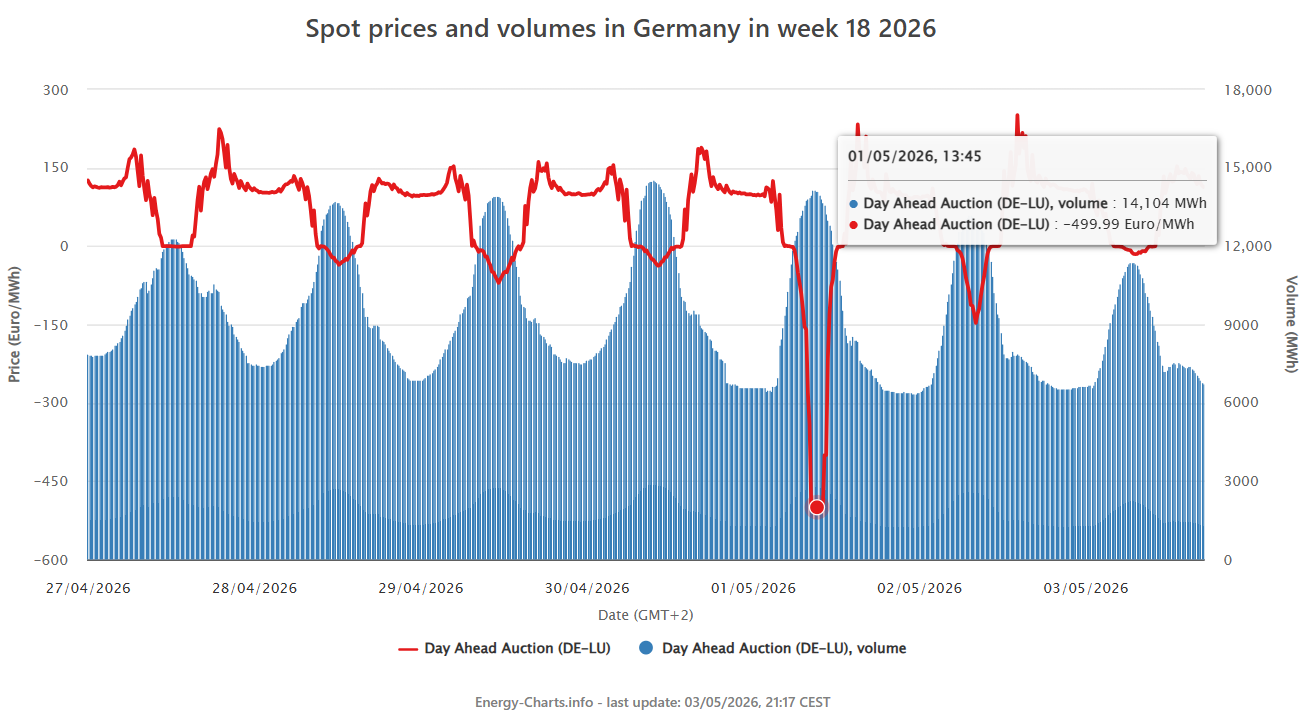
In simple terms, the system either had to find someone willing to take the excess electricity - even at a negative price - or reduce generation from plants such as solar and wind farms. How is that possible? On one hand we have the most expensive fuel in recent years, on the other the renewable electricity has become so cheap that we are forced to waste it? What is going on?
Why Can Electricity Prices Become Negative?
When it comes to fuel prices, the chain of events is pretty clear. Everyone now is a Hormuz strait expert and can explain the correlation with the oil prices, so I will not dwell on it here. As for electricity, especially from renewables, the situation is a lot less clear. Let’s start with the obvious question - how can electricity price be negative?
In electricity markets, supply and demand must remain balanced at all times because the electricity market has a physical constraint - network frequency. In Europe it is 50 Hz. Too high or too low, you run the risk of grid collapse. So the demand needs to constantly be met with supply for the frequency to be stable.
Demand fluctuates throughout the day - peaks in the morning to midday, a bit lower during the working hours, peaks the second time at the end of the workday, and then reduces for the night. The system tries to match supply to demand, but it is not perfectly flexible.
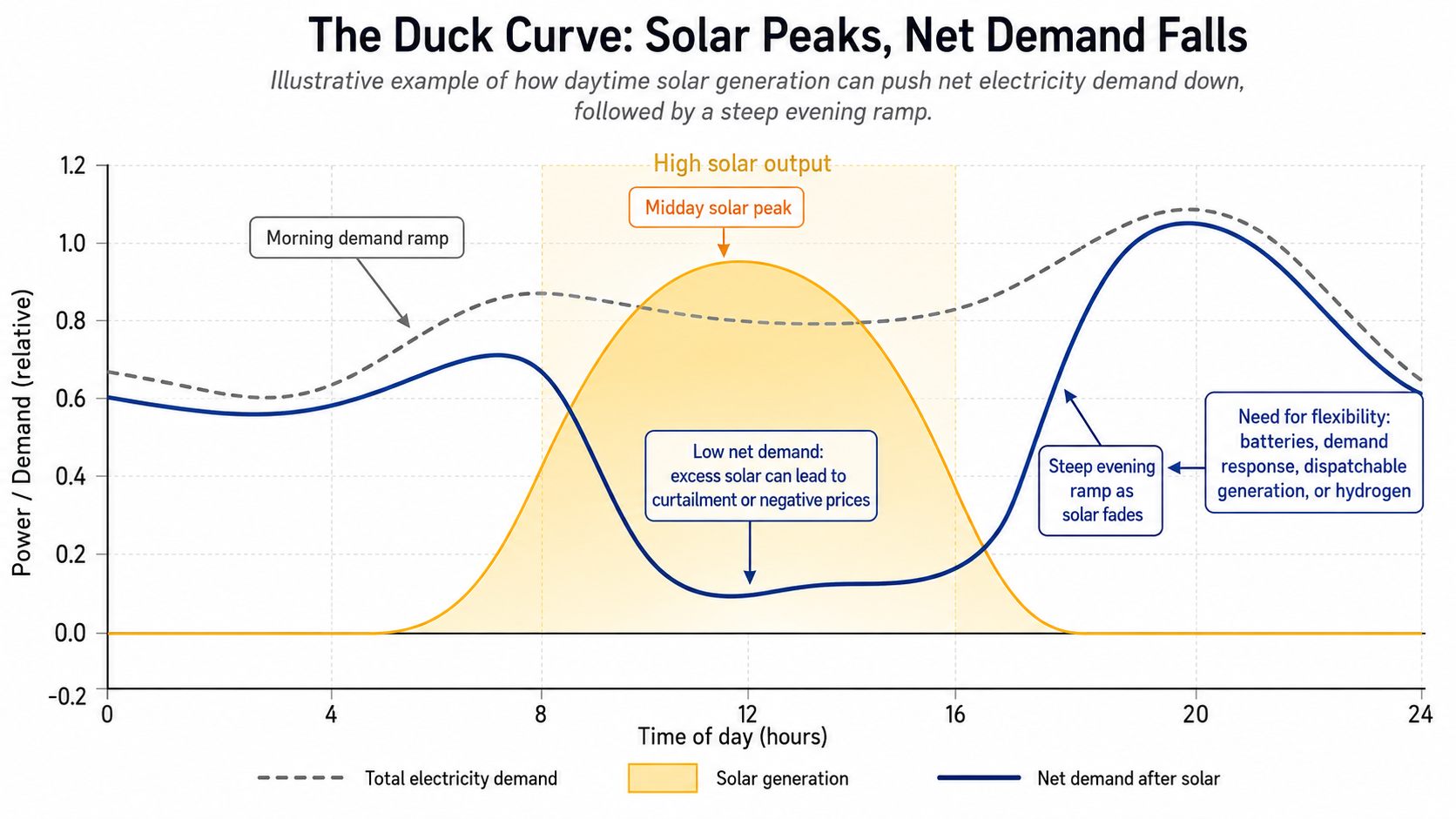
Our grid is fed by both fossil (coal, gas) as well as renewable (sun, hydro, wind) resources. The fossil ones are flexible up to a degree - the electricity companies can ramp up and down the amount generated by feeding more of the fuel. The renewables also ramp up and down (more sun - more power), but this change is out of our control. Thus we have a system that is partially controllable and works well for most of the time, but exceeds its flexibility when there is too much sun or wind.
Negative Prices Are a Warning Signal
When we are getting close to the limits, the market and grid operators need to deal with that excess electricity. How do they do it? First response is what we already saw - negative prices (link to explainer from SMARD). With too much supply, as in every market, the price starts to go down. In the electricity market, the price might actually sometimes go negative to promote excess supply being taken by someone.
Last weekend, however, was very sunny not only in Germany, but in many parts of Europe. Moreover, weekends have lower demand than weekdays as most businesses are closed.
In such cases, if the negative prices are not enough, the grid operators will start limiting the input to protect the grid by, for example, powering down the fossil fuel plants, reducing or sometimes completely switching off the solar and wind plants. This does not happen every weekend, but nevertheless our grid occasionally has to reduce the impact of the renewables to protect itself.
How can it be that we have been focusing now on green electricity for decades that we now have to reduce it? Why can’t we use all of it?
The Real Problem is Flexibility
The answer to those questions is that we don’t have to reduce the amount of renewables, instead we have to get better at managing the overall grid.
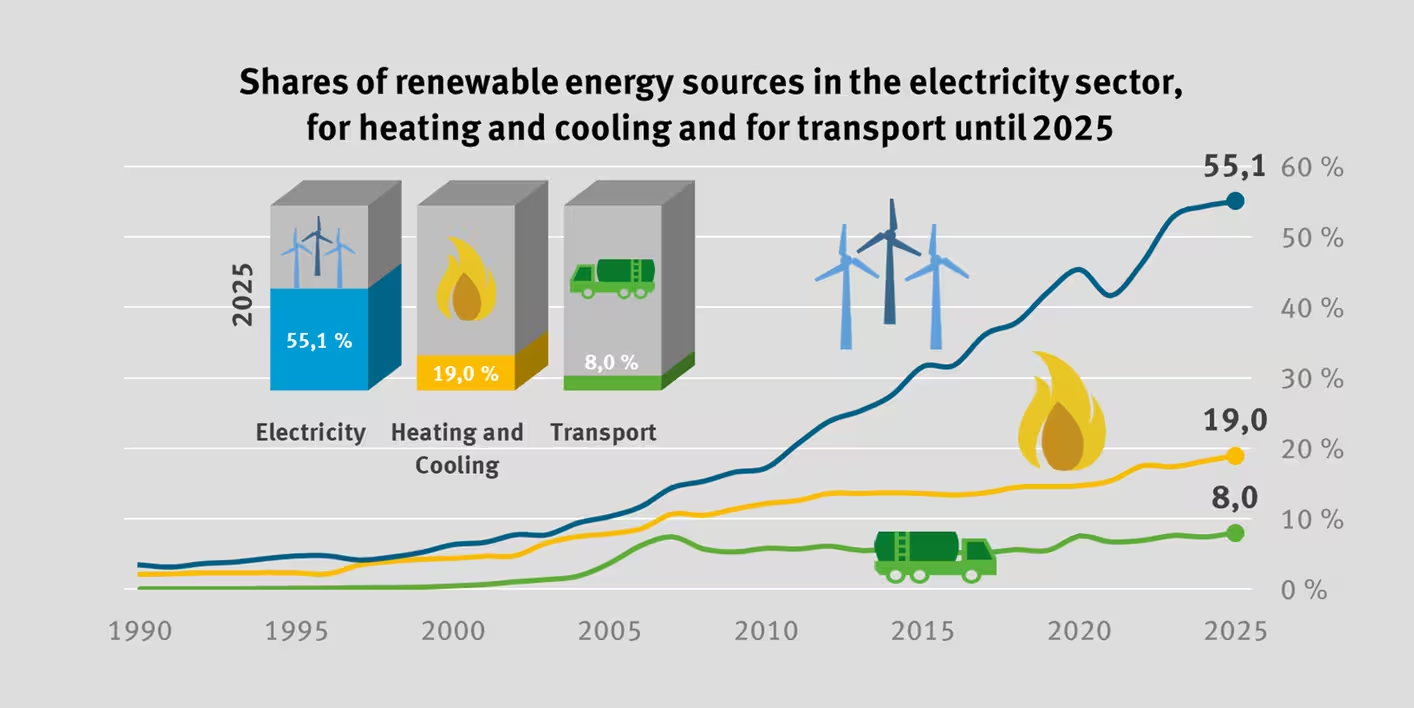
In the recent decades we have moved away from fossil fuel based systems and added a lot of renewables such as wind and solar. How much exactly? For 2025, renewables corresponded to 55.1% of electricity demand in Germany (Umweltbundesamt):
What has not happened at the same pace, however, is the expansion of transmission networks. Germany has a lot of wind farms in the northern and coastal regions of the country for the simple fact that those are the windiest regions. What those regions do not have a lot of, however, are plenty of large, industrial consumers. Those are mostly concentrated in the southern part of Germany. To supply them with plentiful wind energy, the north-south transmission corridor is being built, but it is delayed already for many years.
As a result, electricity from northern Germany can create loop flows through neighboring countries such as Czechia and Poland before reaching southern Germany (link to explainer). This issue is not unique in Germany, in many European countries the expansion of generation capacity has leapfrogged that of the transmission networks. Does it mean that the only solution to avoiding curtailment is more transmission networks?
Three Ways to Reduce Curtailment
Expansion of the transmission network is part of the solution, but it is not the only one. What is ultimately needed is the ability to immediately transmit electricity and to store it for various amounts of time when demand is low. We can divide the possible solutions in three broad categories: moving electricity, short-term storage, and long-term storage.
Stronger grids: Necessary, but not Enough

Transmission network expansion falls into the moving electricity solution bucket. Even though building new electricity lines is a well defined and understandable undertaking, it takes a long time as it involves complex permitting, usage of both public and private lands, approval from local communities, and many other parameters. Therefore, it is not surprising that generation has developed much faster as it affects just a single location.
But even if we were able to expand the grid rapidly, it alone would not solve curtailment due to simple economic considerations. Let us take a solar park with 500 MW installed capacity as an example. During ideal sunny conditions it might briefly approach its full output, but across the entire year its average output would be far lower. In Germany, solar parks typically operate with a capacity factor of roughly 15%, meaning that on average throughout the year the plant would generate electricity closer to 75 MW rather than 500 MW. Building the surrounding transmission infrastructure fully for every rare peak production event would therefore become increasingly expensive and economically difficult to justify. Some degree of curtailment during exceptionally sunny periods may simply be cheaper than massively overbuilding the grid for conditions that occur only occasionally.
Short-Duration Storage: Moving Solar From Noon to Evening

What about short term storage solutions? Today we have two main choices: batteries, and pumped hydro. Batteries are increasingly used as a solution to balance the grid by smoothing out the dips and peaks in the supply-demand equation, and to capture some of that extra electricity. They are a great tool for this as they can not only absorb the excess energy, but also release it quickly in case of a sudden shortfall.
Great! So let’s use more of them to reduce curtailment? As tempting as it may be, batteries do have limitations. Let’s use the previous example of a 500 MW solar park. The plant may only produce close to 500 MW during a limited number of hours, while its annual average output is much lower. If we wanted to absorb every sunny day completely, we would need either enough grid capacity, enough local demand, or enough storage for those peak hours. For example, if there was excess of 400 MW output for four hours, the required battery size would already be around 1.6 GWh. Is that a lot? As of now, the largest solar farm in Europe is 650 MW near Leipzig (Move On Energy), Germany, whereas the largest grid battery is in Scotland at 300 MW / 600 MWh capacity (Zenobe). So we would need about 3x the size of the current largest battery to have a chance of eliminating curtailment of the largest solar plant.
Despite the impressive capacity, a large battery system would require only 4 - 6 hectares - not a lot when compared with the solar park itself. A 500 MW solar park could easily occupy several hundred hectares, so the battery might take up around 1% of the project area. That is not a large increase, but additional costs would be required for new permitting, grid connection, fire-safety spacing - all considerations that make it less appealing to build batteries for rare peak events.
Pumped Hydro: Proven, Large, but Geographically Limited

Another short term storage solution is pumped hydro - water is pumped from a lower reservoir to a higher one using excess electricity. When electricity demand increases, the water flows down and spins a turbine generating electricity.
Simple and straight forward solution. However, not without its drawbacks. For one, it is most appealing only in mountainous and hilly areas to avoid spending extra on building the height difference. Such locations are often far from major demand centers and may require additional grid infrastructure to handle large power transfers.
Batteries are more efficient: they can often return around 85–95% of the electricity put into them, while pumped hydro typically returns around 70–85%. But pumped hydro can store very large amounts of energy for longer periods and can last for decades, whereas batteries are usually better suited for short-duration balancing, such as shifting solar power from midday into the evening.
Hydrogen: Turning Excess Electricity Into Molecules
Finally, we have long-duration storage. This could be the most interesting category as it has the potential to not only reduce curtailment, but also help with storing energy across seasons. Unlike batteries, which are best suited for balancing the grid over minutes or hours, these approaches could help us deal with a much bigger problem - what to do with excess renewable energy generated in summer that might only be needed months later in winter.
One such solution is hydrogen. Instead of switching off wind turbines or solar parks during periods of excess generation, the electricity could be used to power electrolyzers that split water into hydrogen and oxygen. The hydrogen could then be stored and used later either for industry, electricity generation, or potentially transport.
This is attractive because hydrogen storage could scale to very large quantities and, unlike batteries, does not self-discharge significantly over long periods. In other words, hydrogen is not competing with batteries directly - it solves a different problem. Batteries are excellent for shifting electricity from midday to evening, while hydrogen could potentially shift energy from summer to winter.
Of course, hydrogen is not a perfect solution either. Every conversion step comes with efficiency losses. Electricity is converted into hydrogen, compressed or stored, transported, and eventually converted back into electricity or used elsewhere. The overall efficiency is therefore significantly lower than that of batteries. Hydrogen can help with surplus electricity, but it is unlikely to be economical if the electrolyser only runs during rare negative-price hours. Denmark, for example, has increasingly explored linking its large wind generation capacity with hydrogen production to make use of excess renewable electricity that would otherwise be difficult to absorb into the grid (HyBalance Project).
Heat Storage: The Boring Solution That Might Matter a Lot
Another interesting long duration storage is storing excess electricity as heat. At first glance this may sound inefficient or even simplistic, but heat storage is actually one of the cheapest forms of energy storage available. Instead of storing electricity directly, excess renewable power can be used to heat large volumes of water, sand, rocks, or other thermal materials. The heat can then later be used for district heating systems or industrial processes.
This approach is particularly interesting in Northern Europe, where district heating systems are already widespread (Solmax). Finnish startup Polar Night Energy, for example, has experimented with sand-based heat batteries, capable of storing renewable energy for long periods. Such systems are relatively simple, use abundant materials, and could help smooth out seasonal differences between renewable generation and heating demand. In a future renewable-heavy energy system, it is entirely possible that some of our excess summer solar power will eventually keep homes warm during winter months.
Curtailment Is Not Failure
Ultimately, curtailment itself is not proof that renewables have failed. In reality, some degree of curtailment will probably always exist in highly renewable electricity systems because building infrastructure for every rare peak event would simply be uneconomical. The real challenge is therefore not eliminating curtailment entirely, but reducing it intelligently through a combination of stronger grids, short-term storage, flexible demand, hydrogen production, and thermal energy storage. The goal should not be zero curtailment, but rather smart curtailment.